
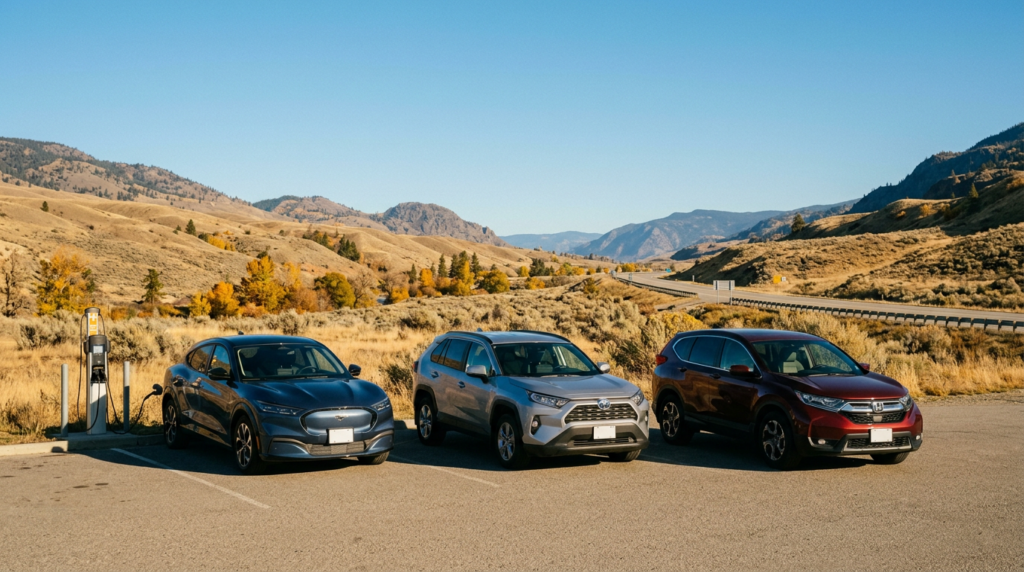
How to Choose the Right Powertrain for Your Real Canadian Driving Life
The smartest vehicle is not automatically the newest technology. It is the one that fits where you drive, how far you go, where you park, and how reliably you can charge.
The Question Has Changed
A few years ago, shopping for a pre-owned vehicle usually meant comparing brands, kilometres, features, and price. Today, Canadian buyers face another important decision: gas, conventional hybrid, plug-in hybrid, or fully electric?
There is no universal winner. A used EV can deliver exceptionally low energy and maintenance costs for a driver with dependable home charging. A conventional hybrid can sharply reduce fuel use without changing how or where the owner refuels. A gasoline vehicle may still be the practical choice for remote travel, towing, irregular long-distance driving, or buyers prioritizing the lowest acquisition price.
The right way to choose is not to debate which technology is “best.” It is to match the powertrain to the driver.
Four Choices, Simply Explained
A gasoline vehicle uses an internal-combustion engine and is refuelled at a gas station. It offers the broadest selection in the used market, quick refuelling, and familiar service requirements.
A conventional hybrid combines a gasoline engine with an electric motor and a small battery. The battery recharges through the engine and regenerative braking, so the vehicle never needs to be plugged in. Natural Resources Canada says a typical hybrid can use 20–40% less fuel than a comparable gasoline-only vehicle, with the largest advantage often appearing in stop-and-go city driving.natural-resources.canada+1
A plug-in hybrid, or PHEV, has a larger battery that can be charged externally. It can cover shorter trips using electricity and then continue on gasoline after the electric range is depleted. A PHEV does not have to be plugged in to drive, but Natural Resources Canada notes that it will not achieve its best fuel economy unless it is charged regularly.publications.gc+1
A battery-electric vehicle, or EV, runs entirely on electricity. It has no gasoline engine, no oil changes, and fewer mechanical components in its drivetrain, but its day-to-day convenience depends heavily on access to charging.canada+1
| Powertrain | Best fit | Main advantage | Main trade-off |
|---|---|---|---|
| Gas | Remote travel, towing, low upfront budget | Fast refuelling and broad availability | Highest routine fuel and engine-maintenance exposure |
| Hybrid | City and mixed driving without home charging | 20–40% potential fuel savings over gasnatural-resources.canada | Still has a gasoline engine to maintain |
| Plug-in hybrid | Short daily trips plus regular road travel | Electric commuting with gasoline backup | Savings depend on plugging in consistentlypublications.gc+1 |
| EV | Predictable commuting with home charging | Lowest energy cost and fewer routine drivetrain services | Winter range and public-charging planning matter |
When a Used EV Makes Sense
A pre-owned EV can be one of the strongest values in the market when three conditions line up: the buyer can charge at home, the vehicle has enough winter range for the longest routine day, and the battery’s condition is documented.
Home charging is where the economics become compelling. Canadian estimates generally place home electricity at a fraction of the cost of gasoline, although the exact savings vary by province, utility rate, vehicle efficiency, and gas price. CAA research comparing two similarly sized Toyota SUVs estimated approximately $2,775 per year to fuel the gasoline model for 15,000–20,000 kilometres, compared with roughly $625 in electricity for the battery-powered model; over five years, the estimated energy-cost difference was $10,750.thinkev+2
EVs also remove oil changes, spark plugs, exhaust-system work, and several other engine-related services. CAA estimates EV maintenance can be 40–50% lower than maintenance for a comparable gasoline vehicle, although EVs still require tires, brakes, suspension work, cabin filters, cooling-system service, and other normal wear items.canada+2
A used EV is especially well suited to:
- A commuter with a predictable daily route
- A household with a driveway or garage and access to overnight charging
- A two-vehicle family that can use another vehicle for unusual long-distance trips
- A high-kilometre driver whose energy savings can offset the purchase price quickly
- A buyer willing to plan around reduced winter range
The Battery Report Rule
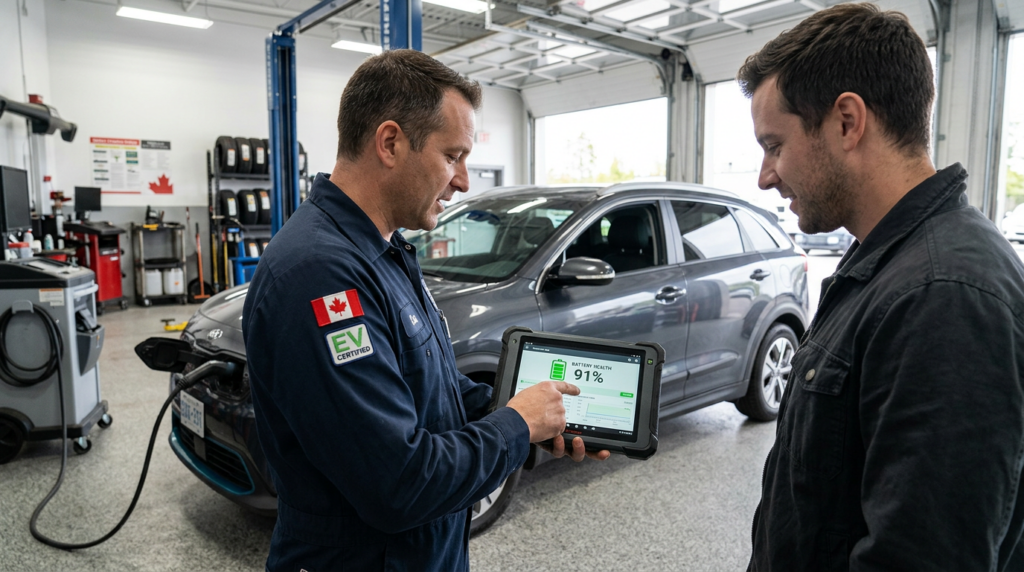
A gasoline-vehicle shopper asks about engine condition. A used-EV shopper must ask about battery state of health, usually abbreviated as SoH.
State of health measures how much usable capacity remains compared with when the battery was new. Every expert interviewed by CBC for its 2026 used-EV guidance stressed the importance of obtaining this report before purchase; one expert advised against buying when health is near 70%. A dashboard range estimate is not a substitute because it can change with recent weather and driving behaviour.cbc+1
Ask the seller or dealer for:
- A written high-voltage battery state-of-health report
- The original in-service date and remaining battery-warranty terms
- Recall records and proof that required battery work was completed
- Charging-history information when available
- Confirmation that the charging port, cable, thermal-management system, and software are operating correctly
- A pre-purchase inspection by a technician familiar with EVs
Battery warranty terms vary by manufacturer and model. Many Canadian EVs were sold with high-voltage battery coverage around eight years or 160,000 kilometres, but buyers should verify the exact warranty using the VIN and original in-service date rather than relying on a general assumption.groupelauzon+1
The practical rule is simple: do not buy a used EV on appearance and displayed range alone. Buy it on verified battery condition.
Canadian Winter Reality

Cold weather does not make EVs unusable, but it does make range planning essential.
A CAA cold-weather test recorded 307 kilometres of travel from a vehicle with an official 410-kilometre rating, about 25% below the official figure under the test conditions. Other Canadian guidance commonly places winter range loss in the 10–30% range, depending on temperature, battery chemistry, cabin heating, driving speed, wind, tires, and whether the vehicle has a heat pump.groupelauzon+3
That means buyers should shop for their worst regular winter day, not their average summer commute. If a round trip is 100 kilometres, a used EV with only 120 kilometres of realistic winter range leaves too little margin. A vehicle that can comfortably complete the same trip while preserving a charging buffer is a much better fit.
Useful winter features include:
- Battery preconditioning before fast charging
- Scheduled cabin preheating while connected at home
- A heat pump, which can reduce heating-related energy use
- Heated seats and steering wheel, which warm occupants efficiently
- Enough battery capacity to preserve a practical winter reserve
For drivers regularly travelling remote BC highways, towing, or covering unpredictable distances in severe weather, a hybrid or gasoline vehicle may remain the more convenient choice.
Why a Hybrid Is the Safe Middle
A conventional hybrid is the easiest electrified vehicle to adopt because the driver does not need to change any habits. There is no home charger to install, no public charging network to learn, and no winter charging stop to plan.
The fuel-saving advantage is strongest in urban and mixed driving, where regenerative braking captures energy that a conventional vehicle would lose as heat. For a commuter navigating Kamloops traffic, school runs, and regular stop-and-go driving, a used Corolla Hybrid, RAV4 Hybrid, CR-V Hybrid, or similar model can reduce fuel consumption while preserving the familiar five-minute gas-station stop.natural-resources.canada+1
A hybrid is often the best answer for:
- Condo or apartment residents without reliable charging
- Drivers who make frequent long trips
- Buyers who want lower fuel use without range anxiety
- Households with only one vehicle
- Rural drivers who need maximum refuelling flexibility
The trade-off is that a hybrid still contains a gasoline engine and its related maintenance requirements. Buyers should verify the hybrid-battery warranty, review service history, and arrange a proper pre-purchase inspection just as they would with any other used vehicle.
When a PHEV Works

A plug-in hybrid can be excellent when its electric range covers the normal commute and the owner charges it every night. It can be disappointing when it is treated like a conventional hybrid and rarely plugged in.
Canadian Energy Regulator analysis shows that PHEV efficiency is highly trip-dependent: short trips can use very little gasoline, while long trips after the battery is depleted move consumption closer to that of a conventional hybrid. In other words, the purchase only makes financial sense if the owner uses the plug.cer-rec.gc
A PHEV is a strong match for someone who:
- Drives a short, repeatable route most days
- Can charge at home or work
- Takes occasional long road trips
- Wants electric driving without depending entirely on charging infrastructure
Before buying used, check both systems. The gasoline engine needs conventional service records, while the high-voltage battery, charging equipment, and electric-drive components require EV-specific evaluation.
When Gas Still Wins
Gasoline vehicles remain the most practical option for many Canadians. They offer the widest pre-owned selection, often the lowest initial purchase price, and predictable refuelling almost anywhere.
A gas vehicle may be the smarter fit for:
- Frequent towing or heavy hauling
- Long, unpredictable highway trips
- Remote travel where charging is limited
- Street parking without dependable charging
- Very low annual driving, where EV fuel savings take longer to offset price differences
- Buyers whose priority is the lowest affordable purchase price today
The mistake is not buying gas. The mistake is buying any powertrain without understanding its complete cost and use case.
A Real Cost Example
Consider two similarly sized used vehicles driven 20,000 kilometres per year.
If the gas model consumes 8.0 L/100 km and gasoline costs $1.55 per litre, annual fuel use would be 1,600 litres and annual fuel spending would be approximately $2,480. If the EV consumes 18 kWh/100 km and home electricity costs $0.12 per kWh, annual electricity use would be 3,600 kWh and the theoretical energy cost would be about $432 before charging losses and fixed utility charges.
Those inputs align with 2026 Canadian estimates that place home charging near $350–$420 per year for 20,000 kilometres at an average electricity rate around $0.12/kWh, versus roughly $2,000–$2,600 for gasoline. Public fast charging can narrow the gap substantially, so the strongest savings generally belong to drivers who do most charging at home.thinkev+2
| Annual energy example | Gas vehicle | EV at home |
|---|---|---|
| Distance | 20,000 km | 20,000 km |
| Consumption assumption | 8.0 L/100 km | 18 kWh/100 km |
| Energy price assumption | $1.55/L | $0.12/kWh |
| Estimated annual energy cost | $2,480 | $432 |
| Illustrative annual difference | $2,048 |
This is an illustration, not a quote. Actual results depend on the model, weather, driving style, local energy prices, charging losses, and how often public fast charging is used.
The Pre-Owned Checklist
Before buying any electrified used vehicle, ask these questions:
For every vehicle
- Does the vehicle history report show accidents, liens, or unresolved recalls?
- Are the maintenance records complete?
- Has the vehicle passed an independent pre-purchase inspection?
- Do the tires, brakes, suspension, and climate-control systems work properly?
- What will insurance cost before signing?
For an EV
- What is the documented battery state of health?
- How much high-voltage battery warranty remains?
- What is the realistic winter range?
- Can the car charge successfully at Level 2 and DC fast chargers?
- Is home charging practical and affordable at the buyer's residence?
For a hybrid or PHEV
- Has the hybrid battery been tested?
- Does the gasoline engine have full service history?
- For a PHEV, does the charging system work correctly?
- Will the vehicle actually be plugged in regularly?
For a gas vehicle
- What is its real-world fuel consumption?
- Does the intended use justify the fuel cost?
- Are major engine, transmission, timing-system, or emissions services approaching?
The Smart-Buyer Decision
Choose a used EV when home charging is dependable, the battery report is strong, and winter range comfortably exceeds the longest regular day.
Choose a used hybrid when lower fuel use matters but charging access is limited or long-distance flexibility is essential.
Choose a used PHEV when daily driving fits inside its electric range and the vehicle will actually be plugged in.
Choose a used gas vehicle when acquisition price, towing, remote travel, or refuelling convenience outweighs the potential energy savings of electrification.
The future is not one-size-fits-all. The smartest pre-owned purchase is the powertrain that reduces cost and inconvenience in the life the buyer already has — not the life shown in an advertisement.
Wondering which powertrain fits your commute and budget? Bring our team your weekly kilometres, longest winter trip, and charging situation. We'll help compare the real numbers without pushing one technology over another.


Recent Comments